

When I first landed in China, I knew maybe ten words of Mandarin. Nǐ hǎo. Xiè xiè. And somehow I thought jiǔ — which means alcohol — was how you say the number nine. Spoiler: it is. But the first time I tried to order “nine beers” at a restaurant, I accidentally said it in a tone that made it sound like “alcohol forever,” and the waiter just stared at me.
Learning Chinese is hard. Let’s not sugarcoat it. The tones, the characters, the fact that mā can mean “mom” or “horse” depending on whether your voice goes up or stays flat — it’s a lot. But after two years in China, I can now hold proper conversations, read menus without Google Translate, and even argue about politics with my taxi driver (badly, but still). Here is what actually worked for me, and what I wish someone had told me before I started.
1. Stop Worrying About Tones — Seriously
Every beginner obsesses over tones. And sure, tone matters. But here is the secret that no textbook will tell you: Chinese people are incredibly good at guessing what you mean from context. If you say “wǒ yào hē shǔi” with completely flat tones instead of “wǒ yào hē shuǐ” (I want to drink water), people will still understand you, especially if you are pointing at a bottle of water while saying it.
I wasted months drilling tones with flashcard apps before I actually started talking to people. That was a mistake. The real learning happens when you say things wrong, get corrected, and adjust. Tones matter, but not enough to let them paralyze you from speaking.
One thing that did help for tones: I recorded myself reading short sentences and compared them with native speakers on the Pleco app. The visual pitch graph showed me exactly where my tone was off. Game changer.
2. Skip the Fancy Textbooks — Use These Apps Instead
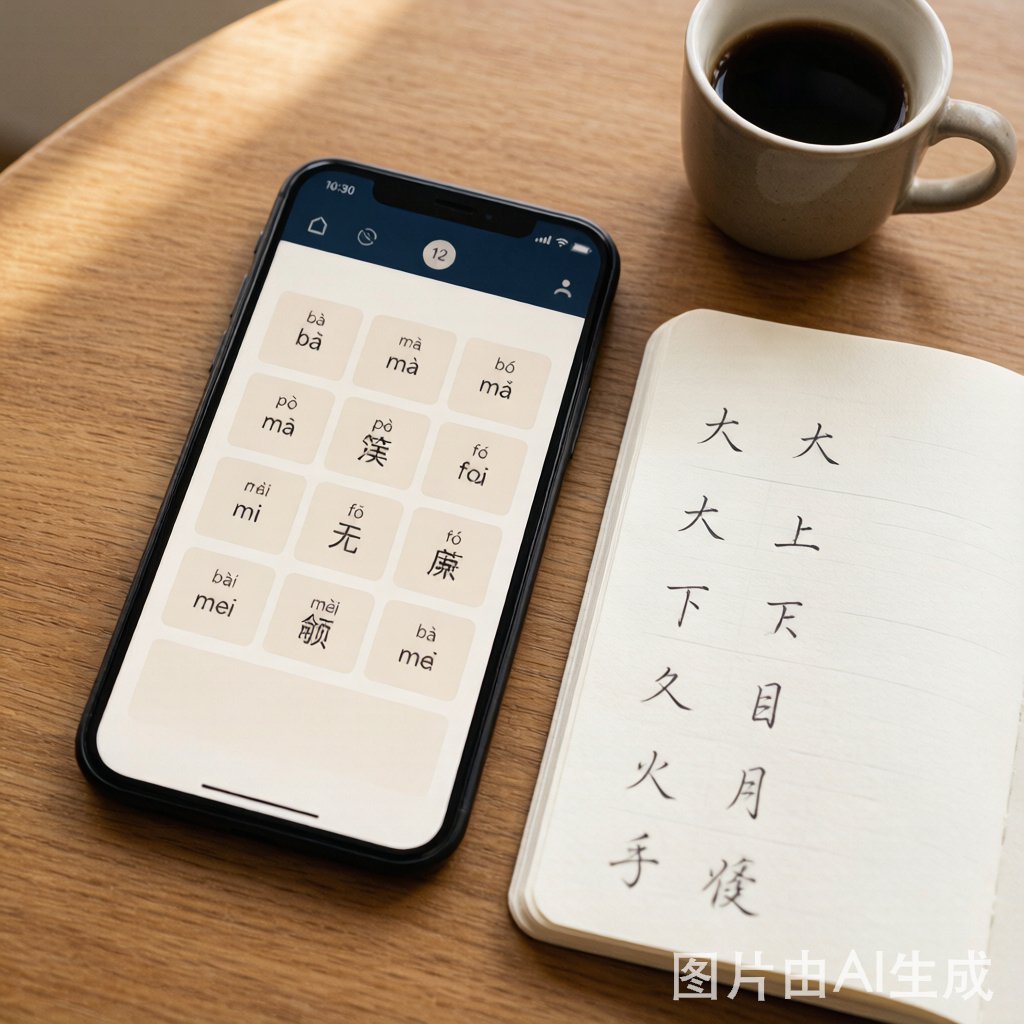
I arrived in China with a suitcase full of textbooks. Integrated Chinese, New Practical Chinese Reader, the whole stack. I have opened them maybe four times total. What I actually used every single day were free phone apps.
Pleco is non-negotiable. It is the best Chinese dictionary app on earth, and the flashcard feature with the spaced repetition system (SRS) is how I learned my first 500 characters. The built-in OCR means you can point your camera at any sign or menu and get instant translations.
HelloChinese is great for absolute beginners. It teaches you pinyin, characters, and grammar in bite-sized lessons that feel like a game. I finished the whole course in three months and went from zero to about 200 characters.
Du Chinese changed everything for me. It offers graded reading materials — short stories, news articles, and dialogues — with built-in dictionary lookup. Tap any word you do not know, and it shows you the meaning. Start at the “Beginner” level where stories are 20 characters long, and work your way up. Nothing improved my reading faster than this app.
3. Find a Language Exchange Partner (Not a Tutor)
There is a huge difference between studying Chinese in a classroom and using it in real life. In class, the teacher speaks slowly and uses only vocabulary you have learned. Real Chinese people speak fast, use slang, and swallow half their words. A language exchange partner bridges that gap.
I found my first language partner on an app called Tandem. We met once a week for coffee — 30 minutes of Chinese, 30 minutes of English. At first, those 30 minutes of Chinese felt like drowning. But after about two months, I noticed I stopped translating in my head before responding. The words just started coming out.
The key is to find someone who is patient but not a teacher. You want someone who will let you struggle for a few seconds before jumping in to help. That struggling time is where the real learning happens.
4. Learn Characters by Writing Them — But Not the Way You Think
Every traditional method tells you to write each character 50 times until your hand cramps. I tried that. I hated it. And honestly, it did not help me remember much.
What worked instead was learning the radicals first. Most Chinese characters are made up of smaller building blocks called radicals. Once you know about 200 radicals, you can look at a new character and guess both its meaning and its pronunciation. For example, 妈 (mā, mom) combines the radical 女 (nǚ, woman) with 马 (mǎ, horse). Mom sounds like horse. That is not a coincidence — it is how the writing system works.
I used an app called Skritter for writing practice. It shows you the stroke order and lets you trace characters on your phone screen. The spaced repetition algorithm serves you the characters you are about to forget right before you forget them. Over six months, I learned about 800 characters this way, spending maybe 15 minutes a day.
5. Talk to Taxi Drivers, Street Vendors, and Old People in Parks
This is the single most underrated language learning strategy. Taxi drivers talk to you whether you want them to or not. Street vendors will happily explain what is in each dish if you show any interest. And elderly people in Chinese parks? They will adopt you on the spot.
I made it a habit to take taxis instead of the subway at least once a week, specifically to practice Mandarin. I would sit in the front seat and force myself to make conversation. “How long have you been driving? What is the best time of day for fares? Do you have kids?” The conversations were always short and simple, but they taught me real, usable Chinese that no textbook covers.
Old people are especially great because they have time and patience. I met a retired teacher in my local park who spent 30 minutes explaining the difference between 了 (le) and 过 (guo) — two particles that native English speakers always mix up. She drew diagrams in the dirt with a stick. I will never forget that lesson.
6. Accept That You Will Sound Like a Child for a Long Time
Here is the hard truth: you will sound like a five-year-old for at least a year. Maybe longer. And that is fine. Five-year-olds learn languages faster than adults precisely because they do not care about sounding stupid.
I remember the first time I tried to tell my roommate that I had lost my keys. What came out was something like “I key no have. Go where?” He understood me perfectly. Did I sound smart? No. Did I find my keys? Yes. That is the goal.
Let go of your ego early. Order food wrong. Ask for the wrong bus. Mix up your tones and accidentally call someone a horse instead of their mother. It happens. Chinese people are not judging you — they are genuinely impressed that you are trying at all. Most foreigners in China never get past “Nǐ hǎo.”

7. Watch Chinese Short Videos — Not Just TV Shows
Everyone recommends watching Chinese TV dramas to learn. And sure, if you want to learn how nobles talked in the Tang Dynasty, C-dramas are great. But for modern, everyday Chinese? Short video platforms like Douyin (Chinese TikTok) are way better.
The videos are 15 to 60 seconds long. They use current slang, real accents from different cities, and everyday situations — people ordering food, arguing with their landlord, making jokes. The comments section is even better. That is where you see how real Chinese people actually write — full of memes, abbreviations, and inside jokes.
I set my phone to show Chinese subtitles on everything. Instagram, YouTube, Netflix — if Chinese subtitles were available, I turned them on. At first I understood maybe 10 percent. After three months, about 40 percent. After a year, most of it. It works because you are not studying — you are just living your normal screen time in Chinese.
8. Learn the Most Common Sentence Patterns First
Chinese grammar is actually way simpler than English grammar. No verb conjugations. No tenses. No gendered nouns. But the sentence structure is different enough to trip you up.
Instead of memorizing long vocab lists, focus on mastering the 20 or so most common sentence patterns. Patterns like:
Subject + 把 (bǎ) + Object + Verb (for handling things)
Subject + 是 (shì) + Noun (to define or identify)
Subject + 在 (zài) + Place + Verb (to do something somewhere)
Subject + 会 (huì) + Verb (can / will do something)
Once you internalize these patterns, you can plug in any vocabulary and make grammatically correct sentences. I spent two weeks drilling just the 把 construction — writing 30 sentences a day — and it unlocked a whole new level of expression for me.
9. Do Not Forget About “Chinese Handwriting” (Typing Is Fine)
Here is something nobody tells you: most Chinese people cannot write every character from memory either. Handwriting is hard. What matters in 2026 is being able to type Chinese.
Learning pinyin input is essential. Once you know pinyin, you can type any Chinese character by typing its romanized form. Your phone or computer will suggest the correct character. This means you can have full conversations in Chinese text long before you can handwrite a single paragraph.
I started texting my Chinese friends entirely in Chinese from month two. My messages were full of wrong characters at first. But autocorrect helped, and my friends corrected me. By month six, I was sending coherent WeChat messages without thinking about it. Reading and typing are both way easier than speaking and writing — start there.
10. Be Consistent, Not Intense
The single biggest mistake I made in my first three months was trying to study for two hours every day. By day four, I was burnt out. By the second week, I had skipped three days. That is worse than studying 15 minutes every day without fail.
What ended up working was a tiny daily habit: one Pleco flashcard session (10 minutes) and one short Du Chinese story (5 minutes). On good days, I did more. On bad days, I did only that. But I never skipped the minimum. Over twelve months, that little habit added up to hundreds of hours of study time.
I also connected my learning to things I already enjoyed. I love cooking, so I started watching Chinese cooking videos on YouTube. I learned food vocabulary, kitchen verbs, and measurement words — all without feeling like I was studying. Find your version of this. If you like K-pop, learn Korean through Chinese platforms. If you like gaming, play Chinese servers. Make the language the tool, not the goal.
Final Thought
Learning Chinese is not about being gifted at languages. It is about showing up, looking stupid, and doing it again the next day. The first six months are brutal. Month three was the worst for me — I felt like I was not making any progress at all. But around month seven, something clicked. Words I had only seen in flashcards started appearing in real conversations. I understood jokes. I could read menu items without pointing at pictures.
If you are coming to China to study, start learning before you arrive. Even 50 characters will make a difference on day one. And once you are here, talk to everyone. The auntie at the campus convenience store. The security guard at your dorm. The guy who sells jiānbǐng (Chinese crepes) outside the south gate. Every conversation is a lesson, and most of them are free.